What Your Reseller Inventory Is Really Costing You
Unsold inventory feels like money in the bank. It is closer to money in a locked box — with fees, time, and taxes waiting at the door. Here is the plain math on what a pile of inventory actually costs, and the one number that tells you whether it is working.
Published August 10, 2026
The pile in the garage is not money in the bank
Every reseller has one: the tote, the closet shelf, or the entire garage bay of things bought to flip that have not sold yet. It is easy to look at that pile and see profit waiting to happen. The harder, more useful way to see it is this: the pile is cash you have already spent, sitting in a form that cannot pay a bill.
That distinction matters because unsold inventory carries costs that do not show up on any receipt. The money is locked up. The item takes space and time. Fees are waiting to take a cut the day it finally sells. And the tax treatment of that purchase is probably not what most new resellers assume.
None of this means reselling does not work — it often works well. It means the sellers who last are the ones who know what their inventory actually costs them, in numbers, not vibes.
Four costs are stacked inside every unsold item
When an item sits unsold, four separate costs accumulate around it. Most sellers track only the first one.
- The purchase price. This is the obvious one — but its real cost is that the cash is unavailable. Fifty items at $8 each is $400 that cannot buy faster-selling inventory, pay down a card, or sit in savings earning interest.
- The platform's cut, waiting at the exit. On eBay, most categories carry a final value fee of 13.6% of the total sale amount (item plus shipping) up to $7,500, plus a per-order fee of $0.30 on orders of $10 or less and $0.40 above that; after 250 free listings a month, insertion fees run $0.35 per listing (verified August 2026, ebay.com). On Etsy, each listing costs $0.20, each sale carries a 6.5% transaction fee on the order total, and US payment processing adds 3% plus $0.25 (verified August 2026, etsy.com).
- Your time. Sourcing, cleaning, photographing, listing, storing, and shipping an item can easily take 30 to 60 minutes end to end. An item that took an hour of work and nets $6 paid $6 an hour. Our guide to a side hustle's real hourly rate walks through that math in detail.
- Space and drag. A death pile has a way of costing more than square footage — items yellow, styles date, seasons pass, and the mental load of a hundred unlisted things is real. Inventory that ages usually sells for less than it would have when it was fresh.
What a $40 sale actually nets, platform by platform
Numbers make this concrete. Take one item: bought for $10, sold for $40, with the buyer paying $8 for shipping — a $48 order total. The shipping label costs you $8. Fee figures below were verified against each platform's published fee schedule in August 2026.
On eBay, the final value fee applies to the whole $48 order: 13.6% is $6.53, plus the $0.40 per-order fee, for $6.93 in fees. After the $8 label and the $10 you paid for the item, you keep about $23.07.
On Etsy, the same order pays a $0.20 listing fee, a 6.5% transaction fee on the $48 total ($3.12), and payment processing of 3% plus $0.25 ($1.69) — $5.01 in fees. After the label and the item cost, you keep about $24.99.
Roughly 40 to 45 percent of that $40 sticker price never reaches you in either case. That is not a scandal — platforms deliver buyers, payment handling, and trust, and that is worth paying for. But a seller who prices as if the sticker price were the payout is quietly overpaying for every item they source. Our free eBay & Etsy Fee Cheat Sheet on the Free Tools page puts both platforms' current numbers side by side on one printable page.
Sell-through rate: the number that separates a business from a pile
Sell-through rate is the percentage of your inventory that sells in a given window — commonly measured over 30 or 90 days. If you have 100 items listed and 25 sell in 90 days, your 90-day sell-through is 25%.
This one number does more work than any other reseller metric, because it converts the pile into a timeline. At a 25% quarterly sell-through, an average item waits about a year to sell. Whatever you paid for the pile, that is how long the cash stays locked up — and the slower the turn, the more the time, space, and aging costs from the last section pile onto each item.
Sell-through also exposes the difference between a good buy and a good story. A $2 item that flips for $30 in a week and a $2 item that sits for two years both looked like bargains at the yard sale. Only one of them was.
There is no single correct sell-through target — it varies by category, price point, and strategy. High-volume clothing sellers often aim to turn inventory in weeks; sellers of rarer, higher-margin items accept slower turns on purpose. The point is not hitting someone else's number. It is knowing yours, watching its direction, and letting it drive what you buy next.
The tax angle most resellers learn the hard way
Three tax facts routinely surprise new resellers. As always, these are general rules — a tax professional can confirm how they apply to a specific situation.
First, buying inventory is generally not an immediate deduction. Under the IRS's normal inventory rules, the cost of an item is recovered through cost of goods sold in the year the item sells, not the year you bought it (IRS Publication 334, verified August 2026). Qualifying small business taxpayers can use simplified methods that treat inventory more like supplies — which method applies to you is exactly the kind of question a tax professional settles quickly. Either way, a garage full of January purchases is not automatically a January write-off.
Second, the 1099-K threshold moved again — upward. Under 2025's tax law changes, the IRS confirmed that payment platforms are required to send Form 1099-K only when a seller's gross payments exceed $20,000 and 200 transactions in a year, reversing the planned $600 threshold (irs.gov, verified August 2026). The catch: taxable income is taxable whether or not a form arrives. Profit from reselling is reportable income even if you never see a 1099-K.
Third, the driving counts. Miles driven for sourcing trips, post office runs, and supply stores can generally be deducted at the IRS standard business mileage rate — 72.5 cents per mile for 2026 (irs.gov, verified August 2026) — if you keep a mileage log. For a seller doing a few sourcing runs a week, that adds up to a meaningful deduction that unrecorded miles simply forfeit.
How to run these numbers on your own inventory
Here is a simple framework many resellers use to audit a pile — a starting checklist to adapt, not a prescription.
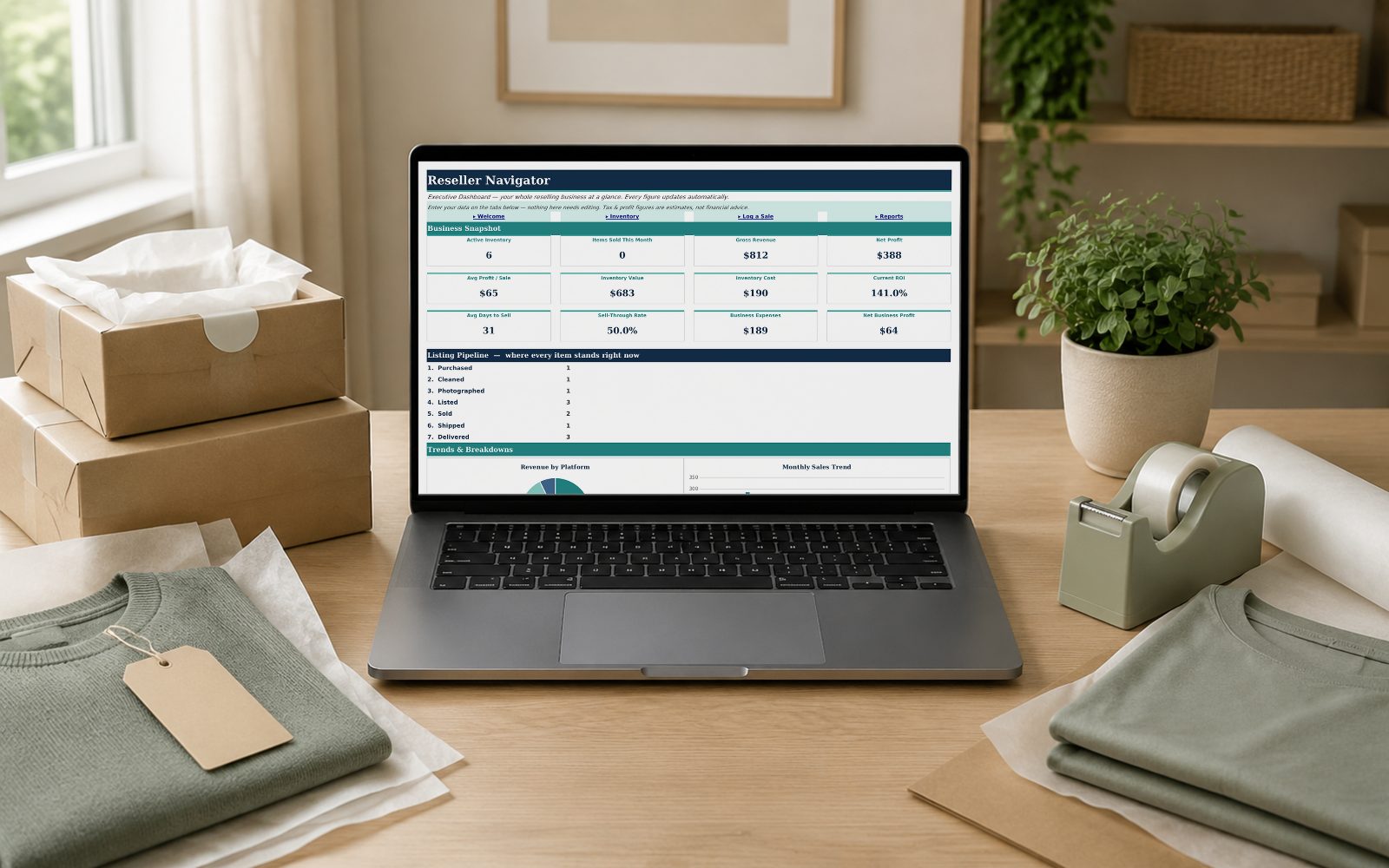
Count and value the pile at cost: what did the unsold inventory actually cost to acquire? Most sellers who do this for the first time find the number is two to three times what they would have guessed.
Compute a 90-day sell-through rate from recent sales, and translate it into a timeline: at the current pace, how many months of inventory are sitting? Flag anything listed over 90 days for a price drop, a relist with better photos, a bundle, or a donation run — aged inventory rarely improves with more waiting.
Then price forward, not backward: before buying the next lot, run the full math — expected sale price, minus platform fees, minus shipping, minus the purchase cost, divided by the time it takes — so every buy has a projected profit and a projected hourly rate before money leaves your pocket. Tracking all of this is exactly what a purpose-built spreadsheet is for; whether you use ours or build your own, the sellers who write these numbers down consistently outperform the ones who keep them in their heads.
Key takeaways
- Unsold inventory is cash already spent — it carries the purchase cost, waiting platform fees, your time, and aging risk all at once.
- On a typical $40 sale, roughly 40 to 45 percent of the sticker price goes to fees, shipping, and item cost before you keep a dollar (eBay and Etsy fee schedules, verified August 2026).
- Sell-through rate converts a pile into a timeline: it tells you how long your cash stays locked up and whether your sourcing is working.
- Inventory purchases are generally recovered through cost of goods sold when items sell — not deducted when bought — though simplified methods exist for qualifying small businesses (IRS Pub. 334).
- The 1099-K reporting threshold is back to $20,000 and 200 transactions, but reselling profit is taxable income whether or not a form arrives (irs.gov, verified August 2026).